
In ceramic flooring, quality does not depend solely on the tile, the adhesive, or the precision of the installation. It also depends on how movement within the flooring as a whole is managed. Changes in temperature and humidity, loads, vibration, and constant use all generate stresses that the flooring must be able to absorb without passing them on to the finish.
When this movement has not been properly allowed for, the problem usually shows up as cracks, lifting tiles, open joints, or localised breakage. They often appear months after handover, when the space is already up and running and any repair involves interrupting its use, removing materials, and redoing part of the installation.
That is why choosing an expansion joint should involve more than just finding a profile of the right height. The level of traffic, outdoor exposure, cleaning products, surface geometry, and the type of stress the flooring will be subjected to must all be factored into the decision. A well-chosen solution helps absorb movement, protects the tile edges, and keeps the finish looking cleaner.
A finished ceramic surface gives the impression of being rigid. However, beneath the finish, the substrate, adhesive, tiles, and joints form a system that responds to environmental conditions. Each material can react differently to heat, cold, moisture, or loads. If there is no controlled point where this movement can be released, the stress ends up concentrated in the most vulnerable areas.
Large surfaces, spaces exposed to temperature changes, and heavily used flooring require special attention. Junctions between materials, changes of plane, and areas where the structure already has a joint are also sensitive points. In these cases, tiling over the movement does not eliminate it. It simply shifts the risk to the tiles themselves or to the joints between them.
An expansion joint creates a zone designed to accommodate this movement. Its purpose is not to hide a break in the surface, but to integrate it into the system so that it works in a controlled way. When it is specified at the design stage, it can serve this purpose without compromising the visual continuity of the flooring.
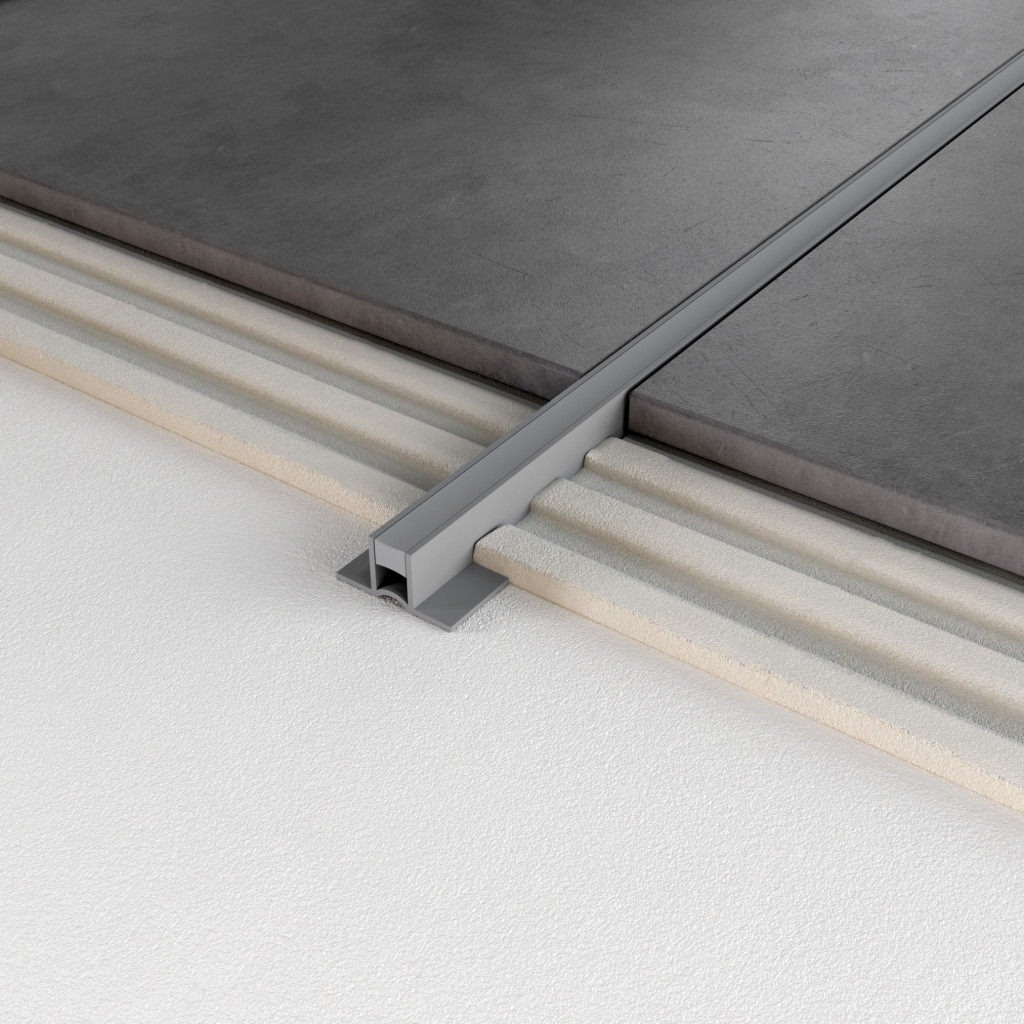
Not all installations work under the same conditions. In a home, traffic is usually moderate and loads are relatively predictable. In a shop, hospital, warehouse, or common area, the flooring may be subjected to constant traffic from people, trolleys, and cleaning equipment, or to point loads. This difference determines the material used for the sides, the strength of the flexible section, and the profile’s ability to retain its shape.
In high-traffic areas, it is worth considering not only how well the joint absorbs movement, but also its resistance to abrasion and fatigue. A joint that performs well in a domestic setting may fall short in a space subjected to repeated mechanical stress. Choosing it based on how intensively the space will actually be used prevents the very element designed to protect the flooring from becoming a point of premature wear.
How the floor will be maintained also matters. The cleaning products in regular use, frequent wetting, and exposure to external agents all affect how the assembly performs. The choice must therefore take into account the conditions the space will face after handover, not just those present during installation.
Indoors, temperatures tend to be more stable, although movement can still be caused by the substrate, by heating and cooling systems, or by the size of the floor area. Outdoors, temperature fluctuations, solar radiation, and moisture can make conditions more demanding. A sunny terrace or an outdoor entrance can undergo significant changes over the course of the day and throughout the year.
The joint chosen must be suited to this level of exposure and continue to perform as conditions change. It must also integrate with the waterproofing system and with any slopes, where these are part of the design. Dealing with movement without taking water or drainage into account can simply shift the problem to another part of the installation.
For this reason, the position of the joints should not be left to improvisation when the final tiles are being laid. They should be planned together with the flooring layout, junctions, and critical details. This makes it easier to keep the layout consistent and avoid awkward cuts that weaken the finish.
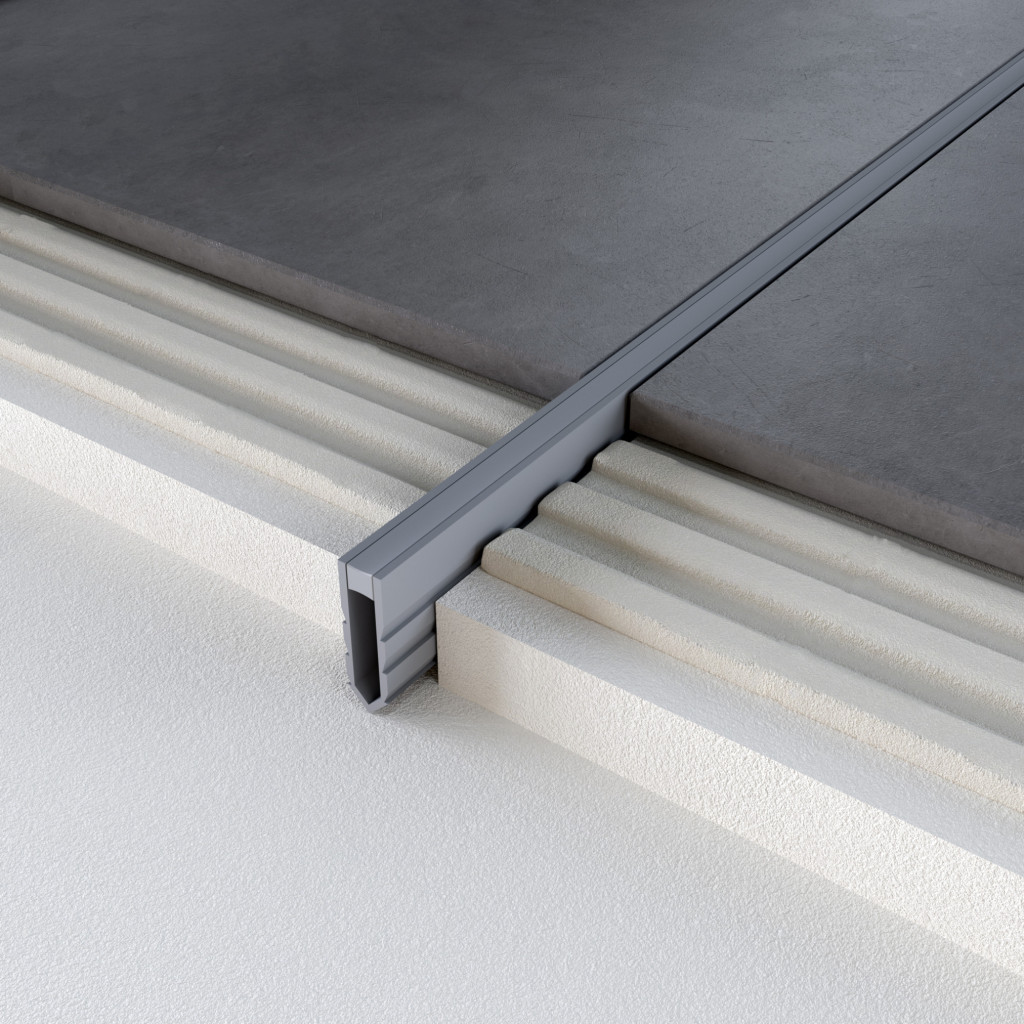
The profile’s material affects how it responds, how durable it is, and how well it blends in visually. Co-extruded rigid and flexible PVC solutions are suitable when lateral stability needs to be combined with a section that can accommodate movement. They are a practical option for ceramic flooring and, depending on their design and height, can suit a range of settings.
Along these lines, Eurojoint 185 combines rigid and flexible PVC for movement joints. Its upper part is designed to absorb compressive and tensile stresses, as well as movement caused by differences in level, so it can be used on indoor or outdoor wall coverings and flooring, including areas subject to mechanical stress such as commercial premises.
Where a solution with a flexible central section is needed to compensate for stresses in flooring, tiles, or natural stone, Eurojoint 186 offers a combination of rigid and flexible PVC that helps prevent the flooring from cracking by absorbing floor movement.
In environments with higher mechanical demands, metal outer profiles provide edge protection and a more technical look. Aluminium combines strength with lightness, while stainless steel is particularly suitable where high resistance to wear, abrasion, or environmental conditions is required.
In high-traffic spaces, Eurojoint 223A combines metal outer profiles with a flexible synthetic rubber central band designed to resist tension, abrasion, and bending fatigue. For installations requiring AISI 304 stainless steel, Eurojoint 223S is designed for joints in indoor or outdoor ceramic flooring and is suitable for domestic, industrial, healthcare, or commercial environments.
Even a well-chosen profile will be less effective if it does not match the thickness of the tiling or is poorly positioned. The height must be matched to the tile, the adhesive, and the planned finished floor level. This allows the joint to blend in without creating raised edges that affect foot traffic, cleaning, or the look of the finish.
The installation must respect the existing joints in the substrate and ensure that the profile is correctly seated. Care should also be taken to ensure that no adhesive residue or other material blocks the section designed to absorb movement. If the flexible section becomes rigid, the system loses the very capacity it was designed to provide.
In metal profiles with a flexible band, levelling and edge protection are particularly important. Precise installation helps spread traffic loads evenly and prevents the edge of the flooring from being left exposed. The aim is for the joint to become part of the finish while remaining free to move.

There is a common belief that an expansion joint visually interrupts the flooring. In reality, what usually spoils the result is adding it late, without regard to the layout of the space. When planned from the outset, it can be aligned with the main axes, changes of material, doorways between rooms, or natural divisions in the design.
Planning ahead in this way makes it possible to choose colours, finishes, and materials that complement the tiling. It also makes coordination between design and installation easier, reduces last-minute adjustments, and helps explain to the client why that visible line serves a necessary purpose. A well-integrated joint is not an aesthetic compromise, but a sign that the flooring has been designed to perform.
Planning it properly also makes maintenance easier. Junctions are more clearly defined, edges remain protected, and it is easier to check the condition of the flexible section. In professional settings, where any problem can disrupt operations, this ease of inspection and upkeep provides added value.
The final choice should start with a simple question: what movements and stresses will this flooring have to absorb over its service life? From there, the factors to weigh up are the indoor or outdoor location, traffic intensity, exposure to moisture or frequent cleaning, the presence of trolleys or loads, the thickness of the tiling, and the level of aesthetic integration required.
No single joint is right for every project. A PVC solution can perform well in many applications, while a profile with aluminium or stainless steel outer sections may be more suitable for areas subjected to heavier use. The key is to match the profile’s performance to the actual conditions on site.
Getting expansion joints right is a way of planning ahead. It allows movements to be managed before they turn into cracks, protects the edges of the flooring, and preserves the continuity of the finish for longer. It is a technical detail, but its effect can be seen in both the durability and the perceived quality of the project.
If you need advice on choosing the most suitable expansion joint for your flooring, contact us. At Euroshrink, we will help you assess the type of use, the conditions of the space, and the requirements of the tiling to find a safe, well-integrated, and durable solution.


