
In many projects, problems don’t show up on the day of completion. They appear months later. An unexpected crack. A ceramic edge that breaks easily. A grout joint that turns black prematurely. Almost always, when you trace the cause, the failure lies in the details.
Profiles, joints, and auxiliary elements are often seen as secondary or minor. However, from a regulatory and technical standpoint, they are integral parts of the overall construction system. They are not merely decorative add-ons; they are functional components that work together with the tile, the adhesive, the grout, and the substrate. This is especially clear in solutions such as aluminium profiles for ceramics, technical corner pieces, or expansion joints, which don’t just finish the edges, they protect and organise the entire system.
European standards and the Spanish Building Code (CTE) aren’t designed to complicate construction work; they’re meant to prevent these issues before they occur. Understanding them helps you select better products, install with proper judgement, and reduce both technical and legal risks.
UNE 138002:2023 is the key reference standard in Spain for the execution of ceramic tiling systems. It defines how ceramics must be installed so the entire assembly performs reliably over the long term.
One of the most important aspects for profiles is movement management. The standard makes it clear that ceramic surfaces expand and contract, and this movement must be accommodated through appropriate joints. This is where one of the most common on-site mistakes happens: assuming a metal profile can act as a substitute for a movement joint.
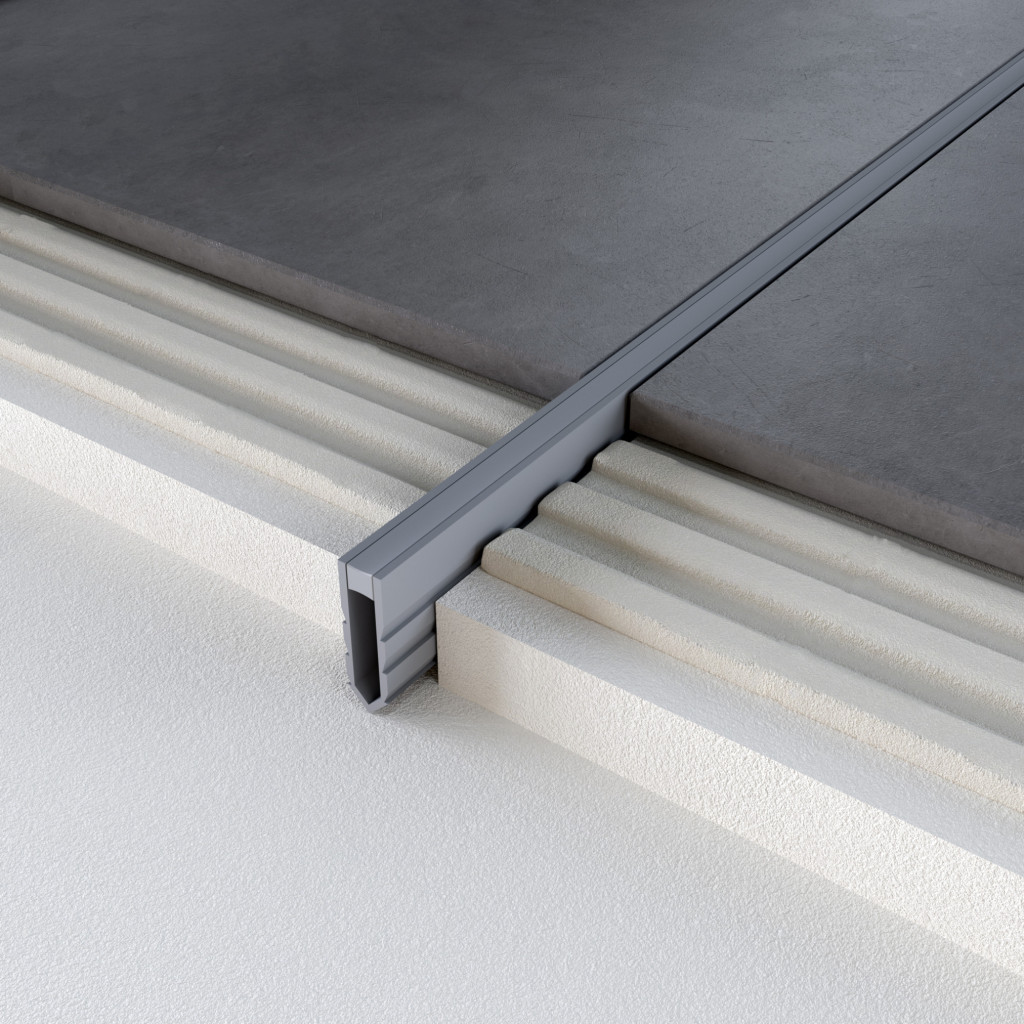
On small surfaces, it might not cause immediate issues, but on continuous floor areas, areas with high solar gain, or spaces with significant thermal changes, the system’s movements will eventually manifest. If there is no space to absorb that movement, cracks or debonding appear. For these situations, there are specific solutions, such as expansion joints designed to integrate into ceramic floors and absorb stress without compromising the finish, for example, the Eurojoint 186. When the project demands even greater absorption capacity due to heavy use or extreme conditions, joints with flexible bands like the Eurojoint 223A are specifically engineered for repeated expansion cycles.
UNE 138002 does not restrict the use of profiles. Quite the opposite: it incorporates them into the system, clearly defining their role and their limitations. The profile finishes, protects, and neatly resolves transitions, but it does not eliminate the need to respect movement joints when the system requires them.
UNE-EN 14411 classifies ceramic tiles according to water absorption, mechanical strength, and intended use. This has a direct impact on the choice and performance of profiles, even if it’s not always taken into account.
Working with an extruded tile is entirely different from working with large-format rectified porcelain tiles. In the latter case, tolerances are extremely tight, and any mismatch with the profile becomes immediately visible. Moreover, denser and more rigid tiles transmit greater stresses to the overall assembly.
From a practical perspective, this standard requires adapting the profile to the type of tile. Dimensions, clearances, and finishes must be consistent with the chosen ceramic material. When they aren’t, problems arise quickly, and they usually concentrate at the edges.
In those cases, finishing profiles and corner guards (such as multi-purpose solutions or metal edge protectors) help safeguard the tile edge and maintain a clean appearance even with demanding pieces. In outdoor applications, where water and dripping put the edges under heavy strain, specific profiles such as aluminium drip profiles make a real difference in both durability and aesthetics.

UNE-EN 12004 governs cementitious adhesives, dispersion adhesives, and reaction resin adhesives. Although the adhesive is often chosen based solely on the tile and the substrate, its behaviour directly impacts the profiles.
In substrates with some deformability or in areas subject to thermal changes, an overly rigid adhesive can restrict the natural movements of the system. That built-up tension eventually releases at the weakest points: joints, edges, and profiles.
That’s why, in systems involving aluminium profiles, compatibility with the adhesive is essential. It’s not just about good adhesion, it’s about ensuring the adhesive works in harmony with the entire assembly without creating unnecessary stresses.
UNE-EN 13888 regulates grouting materials. On site, grout is often one of the most undervalued components, yet it’s one of the most critical for the long-term durability of the system.
When a profile interfaces with grout, their relationship must be properly resolved. The joint width, the type of material, and correct application directly influence the profile’s performance. In wet areas, watertightness and ease of cleaning become especially important.
Many issues with blackening, leaks, or debonding aren’t due to the profile itself but to grout that’s poorly dimensioned or badly executed. The standard helps prevent these mistakes, provided it’s considered from the design stage rather than treated as a final touch-up.
In such areas, interior finishing profiles (such as cove trims for internal corners) make cleaning easier and help keep the junction in good condition with daily use.
In floors subject to traffic, such as commercial zones, entrances, or garages, some profiles go beyond being mere finishers. They become part of systems that bear real loads.
UNE-EN 124 classifies these elements according to their load resistance. If a profile is integrated into such a solution, it must meet a specific load class and maintain its functionality without deforming or compromising the flooring.
Here, installation is just as important as the product itself. A well-made profile can still fail if the substrate isn’t properly prepared or if the system doesn’t transfer loads effectively. The standard doesn’t evaluate isolated pieces, it evaluates assemblies.
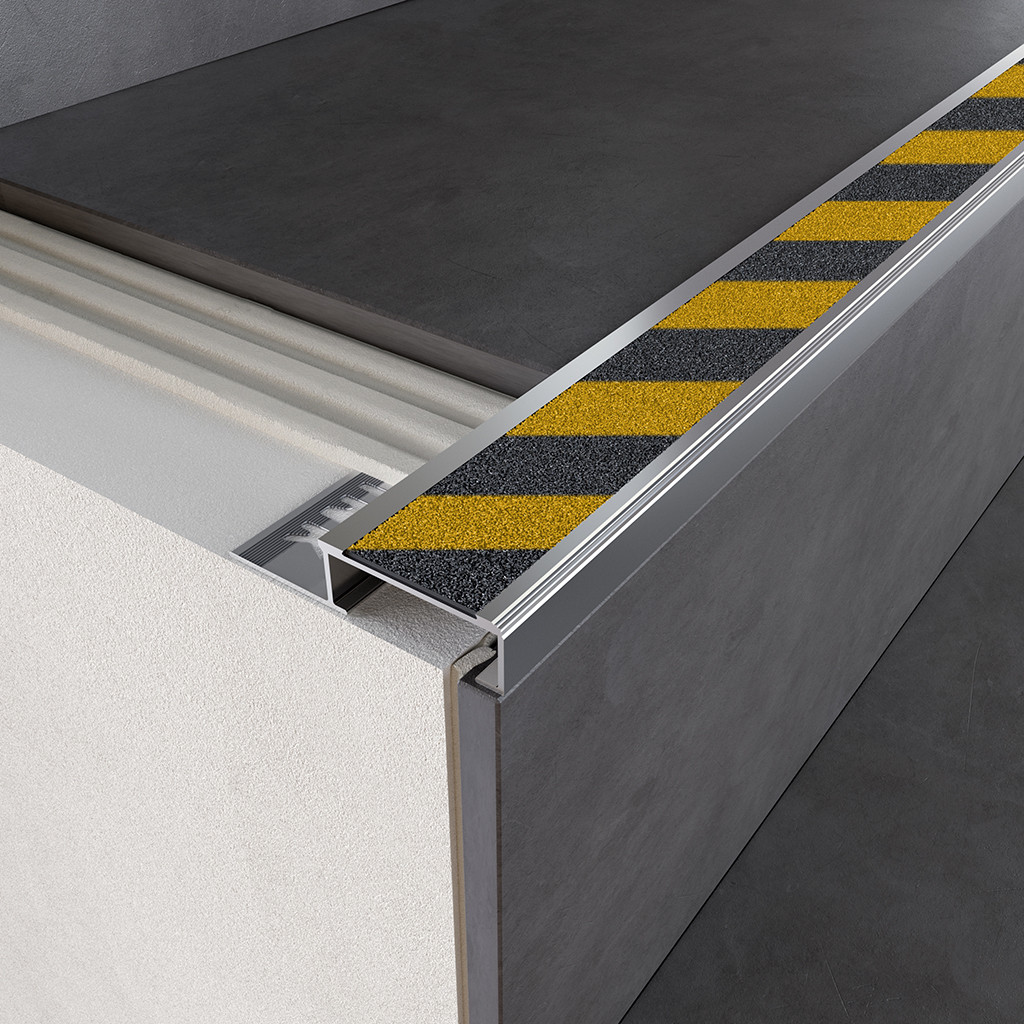
In high-traffic areas, step profiles with anti-slip strips are a great example of how a small detail directly affects safety and maintenance.
The Código Técnico de la Edificación (CTE) is the overarching framework that ties all these standards together in the Spanish context. It doesn’t go into detail on every profile, but it does set the basic requirements that buildings must meet.
From safety in use to hygiene and durability, many of these demands depend on how junctions and details are resolved. A poorly chosen or incorrectly installed profile can become a safety hazard, an area where dirt accumulates, or an entry route for moisture.
That’s why, even though profiles are often decided on site, their selection must align with CTE requirements, not as a mere formality, but as a guarantee that the building will perform properly for years.
Choosing profiles compatible with the tile, adhesive, and grout; respecting movement joints; and accounting for real loads doesn’t complicate the work. It makes it more predictable.
Standards don’t eliminate surprises entirely, but they greatly reduce repetitive errors that lead to rework, claims, and extra costs. And on real job sites, that’s a clear advantage.
Complying with standards isn’t just a theoretical exercise. It’s a way to work better. It means understanding that profiles, though small, have a specific technical function within the construction system.
When they’re properly integrated from the start, the result is more durable, safer, and easier to maintain. And in the day-to-day reality of construction, that always shows.
At Euroshrink, we offer a complete range of technical profiles designed to fit within this regulatory framework and meet the real demands of the job site, from small interior details to solutions for trafficable or exposed areas.
If you’re working on a design where junctions, transitions, or critical zones need a technically sound resolution, schedule a consultation with our team. We’ll help you analyse the system as a whole and select the right profiles to address critical project points before they turn into on-site problems.


